
Virat Kohli’s World Cup record is one of the great statistical oddities of modern cricket.
On the surface, there is very little to criticize. He has been among India’s most prolific run-scorers in World Cups and has produced some of the tournament’s most memorable innings. Yet if we move away from aggregate runs and look at his numbers relative to his teammates, a rather different picture emerges.
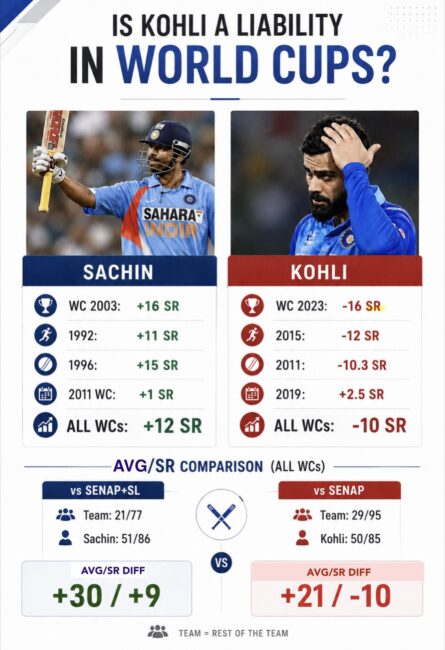
The accompanying graphic compares Sachin Tendulkar and Virat Kohli across their World Cup appearances, looking at two basic measures: batting average and strike rate. More importantly, the figures show how much better or worse each batter performed than the rest of his team.
And the contrast is striking.
Tendulkar was consistently ahead of his team
Across his World Cup career, Sachin Tendulkar’s strike rate was 12 points higher than that of his teammates.
The pattern holds across almost every tournament. In 1992, Tendulkar’s strike rate was 11 points higher than the rest of India’s batting. In 1996, the advantage increased to 15 points. And in 2003, during perhaps his greatest World Cup campaign, it was a remarkable +16.
Even in 2011, when Tendulkar was no longer the player he had been at his peak, he remained marginally ahead of his teammates, with a +1 strike-rate differential.
The significance is not that Tendulkar scored quickly in absolute terms. It is that he was generally scoring faster than the batsmen around him.
Kohli’s numbers tell a markedly different story.
Kohli’s strike rate falls relative to his teammates
Across his World Cup appearances, Kohli’s strike rate is 10 points lower than that of his teammates.
In 2011, it was 10.3 points lower. In 2015, the deficit was 12 points, and in 2023 it widened further to 16 points.
There was one exception: in 2019, Kohli’s strike rate was actually 2.5 points higher than the rest of India’s team.
This doesn’t mean Kohli was a poor World Cup batter. In fact, his average relative to his teammates tells us precisely the opposite.
His problem, if one wants to call it that, is tempo rather than productivity.
Kohli has generally scored substantially more runs than his teammates when he has batted. But he has often done so at a slower rate than the batting around him.
That distinction matters.
Chase King chasing in World Cups
This again tells a very different story, that in world cups chases, it is once again Sachin Tendulkar who excels and Kohli lags.
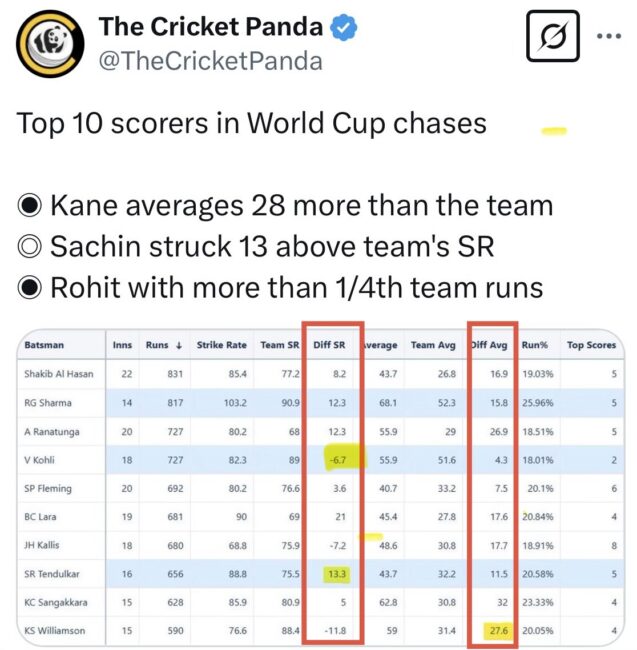
Other than the knock against AUS in India’s opening encounter in the 2023 World Cup, where KL Rahul won the MoTM, Kohli doesn’t have a great chase record.
Average needs context other than era difference
There is also an important caveat when comparing batting averages between Tendulkar and Kohli.
Batting average is calculated using runs divided by dismissals, rather than simply runs divided by innings. A not-out therefore increases a player’s average without adding a dismissal.
This is particularly relevant when comparing an opener like Tendulkar with a No. 3 batter like Kohli.
The graphic happens to show both players with one not-out innings in the World Cup sample being compared, but that doesn’t mean the not-out effect has been equally distributed across their careers. Over their overall international careers, Kohli has accumulated considerably more not-out innings than Tendulkar.
That naturally provides some assistance to Kohli’s career average.
This is also why, when looking at pure productivity, runs per innings can sometimes be a useful supplementary measure. Across their overall international careers, Kohli’s runs per innings are around 49, compared with around 40 for Tendulkar.
The point isn’t that one number is “correct” and the other is “wrong”. It is simply that batting average contains an element determined by how often a player is dismissed, and that can be influenced by batting position and match circumstances.
Batting position affects Avg
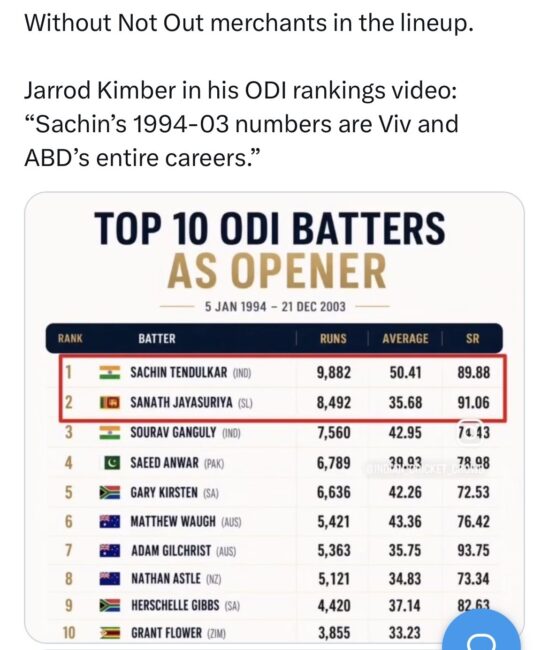
There is another contextual difference that should not be ignored.
Tendulkar spent the overwhelming majority of his career opening the innings. That meant walking out against the opposition’s freshest and most dangerous bowlers, often including the very best fast bowlers in the world.
Think Wasim Akram, Glenn McGrath, Donald, and others of that calibre.
And as an opener, Tendulkar wasn’t merely expected to survive those opening spells. In the ODI game of his era, there was an enormous premium on exploiting the field restrictions early in the innings.
Kohli, by contrast, has spent the bulk of his career batting at No. 3.
That is still an enormously demanding position, but it can offer a different set of circumstances. He is less likely to walk in against two fresh fast bowlers with a brand-new ball and an attacking field. If India gets through the opening spell, Kohli can often encounter the same bowlers later in their spells, or medium pacers and part-timers coming into the attack.
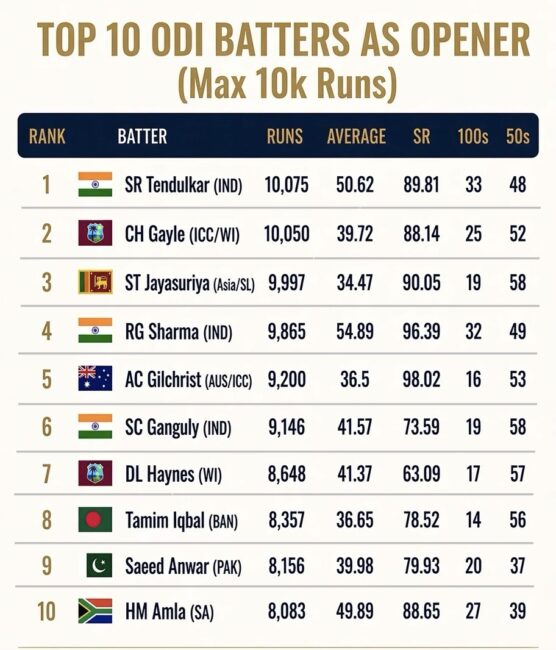
And if he bats deep into an innings, he gets the opportunity to face the specialist bowlers again when the field is spread and the bowlers are exhausted. The 2-new ball era further helped.
None of this diminishes Kohli’s achievements. It simply illustrates why raw batting numbers cannot always be interpreted without considering where and when those runs were scored.

So, is Kohli a liability?
The numbers don’t justify such a straightforward verdict.
His average relative to his teammates demonstrates that Kohli has been an exceptionally productive World Cup batter. The problem is that his strike-rate differential is consistently negative, whereas Tendulkar’s was overwhelmingly positive.
So the more interesting question isn’t whether Kohli scores enough runs. Clearly, he does.
It is whether the rate at which he scores those runs, relative to the batsmen around him, is optimal for a World Cup team.
Tendulkar’s numbers suggest a batter who combined volume with aggression relative to his contemporaries. Kohli’s suggest a batter who has been enormously productive, but whose advantage has come more through accumulation than through outscoring his teammates at the same rate.
That doesn’t make Kohli a liability.
But it does make the question far more interesting than simply counting his runs.

- Sweet And Hydrating Yellow Summer Fruits For Natural Energy - September 23, 2026
- How Same Day Crowns Can Restore Damaged Teeth Quickly - September 19, 2026
- A Practical Guide to Selecting Soil, Dirt, and Aggregate for Common Property Projects - September 18, 2026