
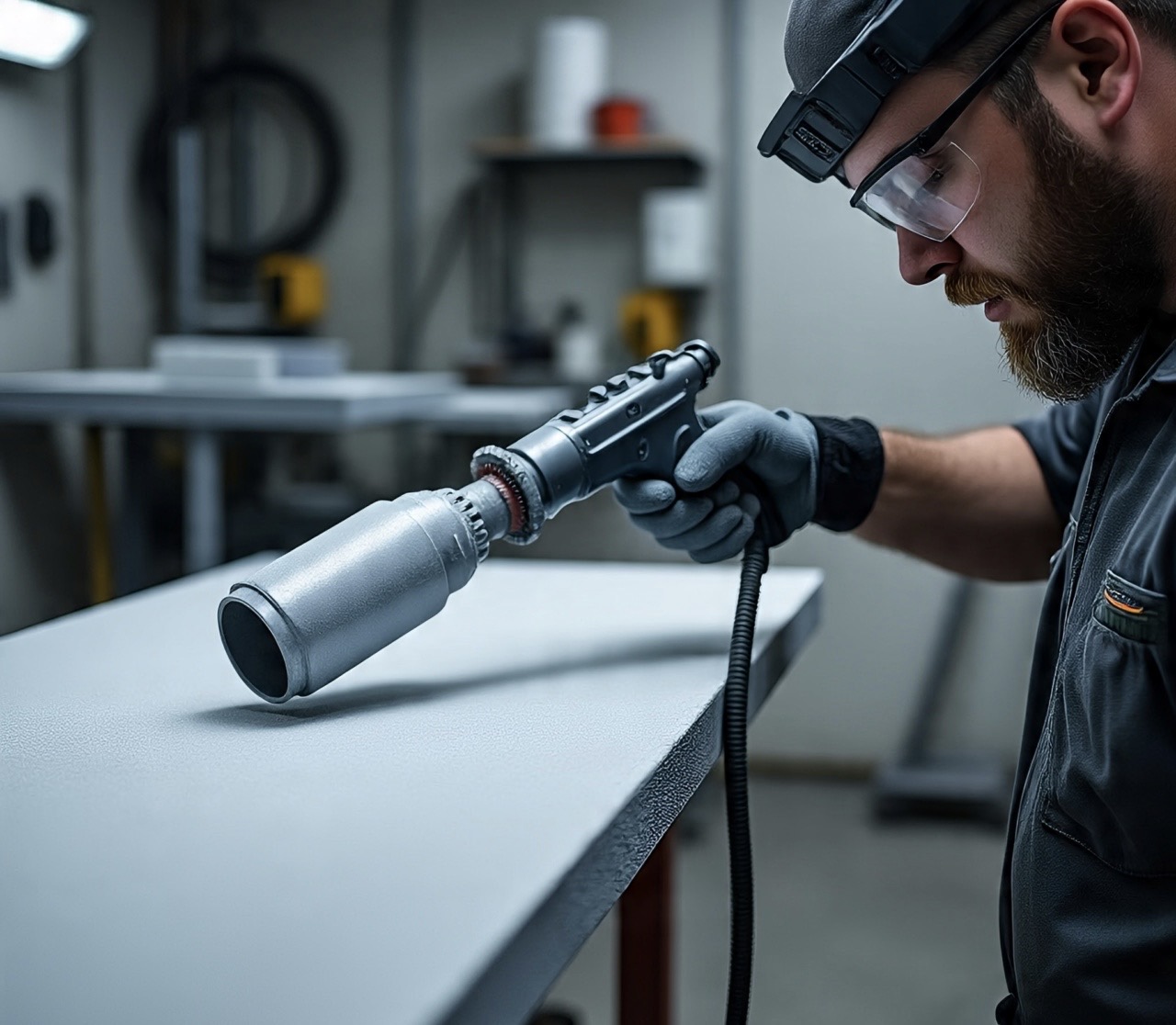
A professional powder coating gun doesn’t just apply color—it defines the smoothness, adhesion, and overall integrity of the coating. The precision of modern powder coating equipment gives fabricators control that older or low-end tools simply can’t match, especially inside an industrial paint booth where conditions demand uniform performance from start to finish.
Steady Output Across Varied Surface Angles
A professional powder coating gun maintains a steady powder charge and flow rate, even when the applicator changes position or moves around complex shapes. This balance comes from advanced electrostatic control systems that regulate how powder particles respond to metal surfaces. Operators using high-quality equipment can move across curved or vertical panels without seeing uneven buildup or light patches.
Cheaper guns often struggle to maintain voltage consistency as the distance from the part changes. This inconsistency creates irregular textures, particularly on parts with deep corners or multiple angles. Inside a controlled powder coating booth, a consistent output ensures that each surface—no matter its angle—receives an equal and durable coat that bonds tightly through curing.
Clean Edges Achieved with Minimal Overspray
Sharp, defined edges distinguish professional finishes from low-quality jobs. A professional powder coating gun uses adjustable air caps and optimized nozzles that reduce overspray while focusing the powder stream exactly where it’s needed. This means fewer wasted materials and less cleanup inside the industrial paint booth.
In contrast, low-grade guns tend to scatter powder beyond target areas, creating fuzzy lines and uneven coating thickness. With professional equipment, operators can achieve crisp transitions even between colors or masked zones, resulting in cleaner contours and reduced rework time.
Balanced Powder Flow Reducing Shadowing
Shadowing occurs when powder fails to reach recessed or obstructed areas. A well-calibrated professional powder coating gun minimizes this issue by maintaining balanced airflow and electrostatic charge. These tools deliver powder deep into corners, ensuring even coverage where airflow turbulence might otherwise block deposition.
Operators working in an industrial paint booth benefit from this balance because it shortens correction cycles. Instead of multiple passes or manual touch-ups, consistent powder flow covers all areas efficiently. Proper grounding and high-voltage control help maintain this stability throughout production runs.
Repeatable Finishes on Textured and Flat Parts
Uniformity matters as much on textured metal as on smooth surfaces. A professional powder coating gun produces predictable results through controlled particle size distribution and steady atomization. Whether coating stamped panels, cast housings, or smooth extrusions, these systems replicate the same finish every time.
Inconsistent tools may deposit uneven layers that look patchy once cured. Within a powder coating booth, repeatability means customers receive identical finishes on large batches without visible variation. This reliability is especially vital in industries such as automotive or construction, where coatings must meet both aesthetic and functional standards.
Fine Control During Tight-radius Passes
Tight corners, small fixtures, and curved profiles demand precision. A professional powder coating gun provides fine-tuned control over voltage, air pressure, and flow rate, allowing operators to maneuver within confined areas without clumping or thin coverage. This feature is key in coating intricate parts like brackets, frames, or custom metal art.
Entry-level equipment lacks this delicate modulation, often forcing operators to overspray and compensate later. In a properly ventilated industrial paint booth, fine control reduces waste and ensures that hard-to-reach sections receive the same durable finish as larger flat panels.
Improved Cling on Recessed Metalwork
Electrostatic attraction defines powder coating success. A professional powder coating gun enhances this attraction through consistent voltage output, improving cling on recessed or hidden surfaces. This uniform electrostatic field helps powder particles adhere even to inverted or shielded sections.
Poor electrostatic control leads to powder bounce-back, especially in deep cavities or around weld seams. With professional powder coating equipment, coverage extends naturally into crevices without heavy overspray, ensuring complete encapsulation and stronger adhesion after curing.
Uniform Coverage During Long Spray Sessions
Extended coating sessions often reveal the difference between professional-grade and budget tools. A high-quality powder coating gun maintains uniform output even during continuous operation. Its components resist clogging, voltage drop, and nozzle wear that can distort the spray pattern over time.
Inside a large industrial paint booth, this reliability translates into consistent finish quality across hundreds of parts. Long runs require equipment that delivers steady powder density without operator fatigue or constant recalibration. This consistency ensures visual harmony and lasting protection across every coated surface.
Reduced Drift in High-humidity Conditions
Humidity affects how powder particles behave in the air and on metal surfaces. Professional powder coating guns counter this with static control systems that stabilize particle charge regardless of moisture levels. This prevents powder from drifting or clumping before it reaches the target.
Less advanced powder coating equipment often loses efficiency in humid conditions, wasting material and creating uneven finishes. In an enclosed powder coating booth, professional-grade systems manage environmental variables effectively, allowing operators to maintain precision and coating density even on challenging days.

- Sweet And Hydrating Yellow Summer Fruits For Natural Energy - September 23, 2026
- How Same Day Crowns Can Restore Damaged Teeth Quickly - September 19, 2026
- A Practical Guide to Selecting Soil, Dirt, and Aggregate for Common Property Projects - September 18, 2026





“This topic is trending right now, but most places are sharing incomplete info. I found a much more detailed and updated version on XenixNews ”